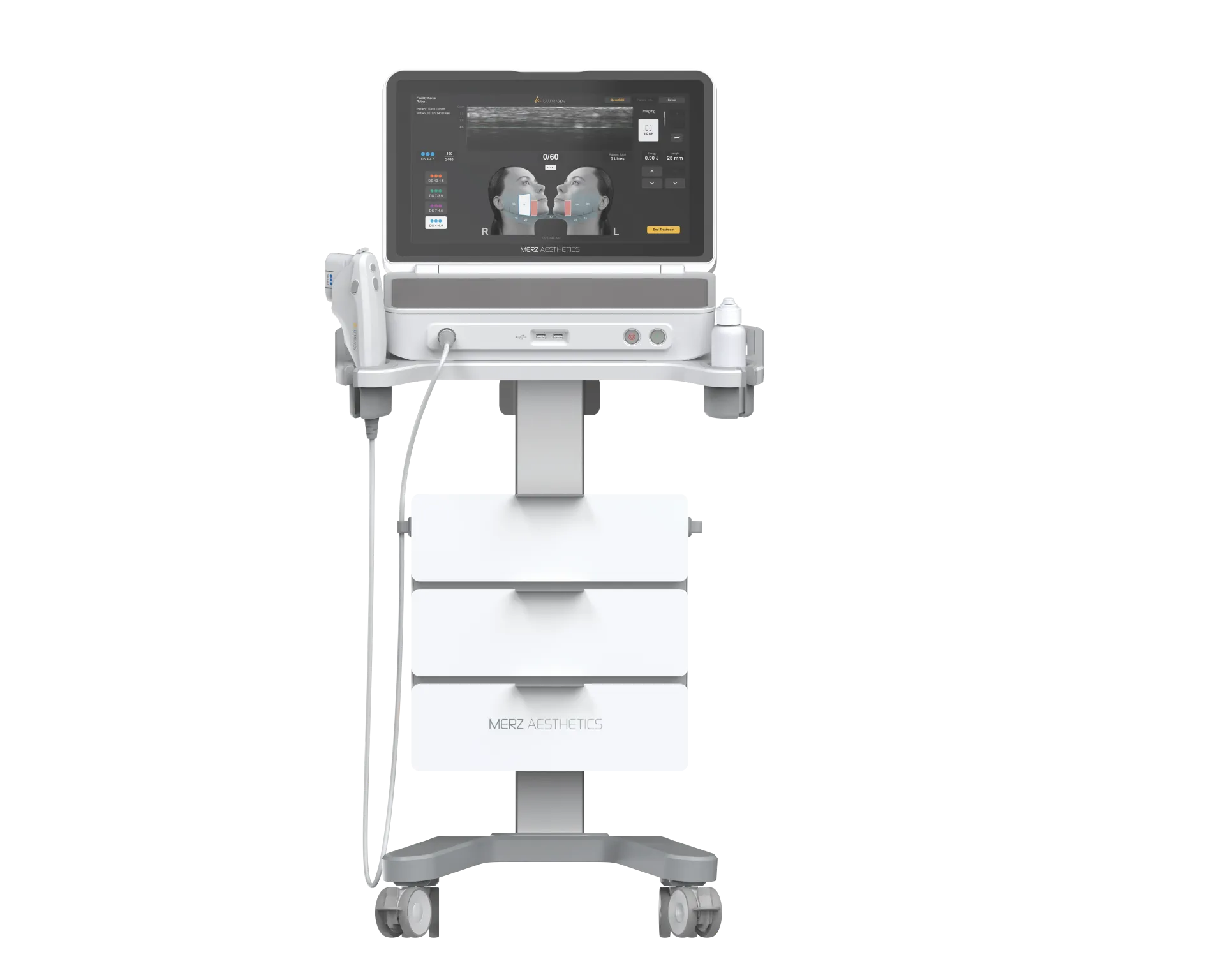
Regulatory Clearance and Ultherapy Safety Record
Ultherapy received FDA 510(k) clearance in September 2009, becoming the first and only non-invasive procedure cleared specifically for lifting the skin on the neck, chin, and brow. In 2012, the FDA expanded clearance to include improvement of lines and wrinkles on the decolletage. The Korean Ministry of Food and Drug Safety (KFDA) granted parallel clearance, confirming that Ultherapy meets safety standards recognized across both Western and Asian regulatory systems.
With over 3 million treatments performed globally, the cumulative safety data shows a serious adverse event rate below 0.1%. The micro-focused ultrasound with visualization (MFU-V) technology allows practitioners to see tissue layers in real time on the device screen before delivering energy, adding a layer of precision that reduces off-target exposure.
How Ultherapy Works at the Tissue Level
Ultherapy delivers focused ultrasound energy to three specific depths: 1.5mm (dermis), 3.0mm (deep dermis), and 4.5mm (SMAS layer). The energy creates thermal coagulation points at temperatures between 60-70 degrees Celsius, triggering a wound-healing response that produces new collagen and elastin fibers over the following 90-180 days. The epidermis remains intact throughout the procedure because the focused beam bypasses the skin surface entirely.
Common Side Effects and Recovery Timeline
Immediate Effects (0-48 Hours)
Redness appears in approximately 85% of patients and resolves within 1-3 hours for most individuals. Mild swelling occurs in 20-35% of cases, particularly around the jawline and periorbital area, fading completely within 24-48 hours. Temporary tingling or numbness in treated zones affects roughly 10-15% of patients and normalizes within the first week. These reactions scale with the number of treatment lines delivered during the session.
Rare and Serious Adverse Events
Bruising occurs in fewer than 5% of treatments and resolves within 7-10 days without intervention. Temporary nerve paresis, presenting as slight weakness in facial muscles, has been documented at a rate below 0.5% and resolves spontaneously within 2-6 weeks. Burns or blistering remain exceedingly rare at under 0.05% incidence when the device is operated according to manufacturer protocols with proper contact and coupling gel application.
Contraindications and Who Should Avoid Ultherapy
Ultherapy is contraindicated for individuals with active skin infections, open wounds, or cystic acne in the target treatment area. Patients with metallic implants such as dental braces or metal plates in the face require assessment, as ultrasound energy may interact with metal surfaces. Isotretinoin use within the past 6 months increases skin sensitivity and healing variability, requiring medical clearance before proceeding with any energy-based treatment.
Pregnancy and breastfeeding represent absolute contraindications due to the absence of safety data in these populations. Individuals with bleeding disorders or those taking anticoagulant medications face elevated bruising risk. Unlike some laser treatments, Ultherapy treats all Fitzpatrick skin types I through VI because ultrasound energy bypasses melanin in the epidermis, making it suitable for a broad range of skin tones without hyperpigmentation risk.
Clinical Evidence for Ultherapy Safety
A pivotal study evaluating 103 subjects receiving Ultherapy for brow lifting demonstrated measurable eyebrow elevation in 86% of participants at 90 days post-treatment, with no serious adverse events recorded during the 180-day follow-up period. Alam M et al. Dermatol Surg. 2010;36(12):2048-2055. doi:10.1111/j.1524-4725.2010.01810.x
Practitioners at RE:BERRY Gangnam follow standardized Ultherapy protocols with treatment line counts calibrated to each patient's facial anatomy and skin thickness, maintaining consistent safety margins across all sessions. Real-time ultrasound visualization confirms that energy targets the correct tissue layer before each pulse fires, reducing operator-dependent variability inherent in non-visualized energy delivery systems.